About the book
BOOK SUMMARY
Augustine's spiritual journey from a life of sensuality and careerism to religious awakening, combining personal confession with sophisticated theological arguments about faith, marriage, and morality.
Published 400 CE
Religion
400 pages
Catholic guilt is really something
May 4, 2026
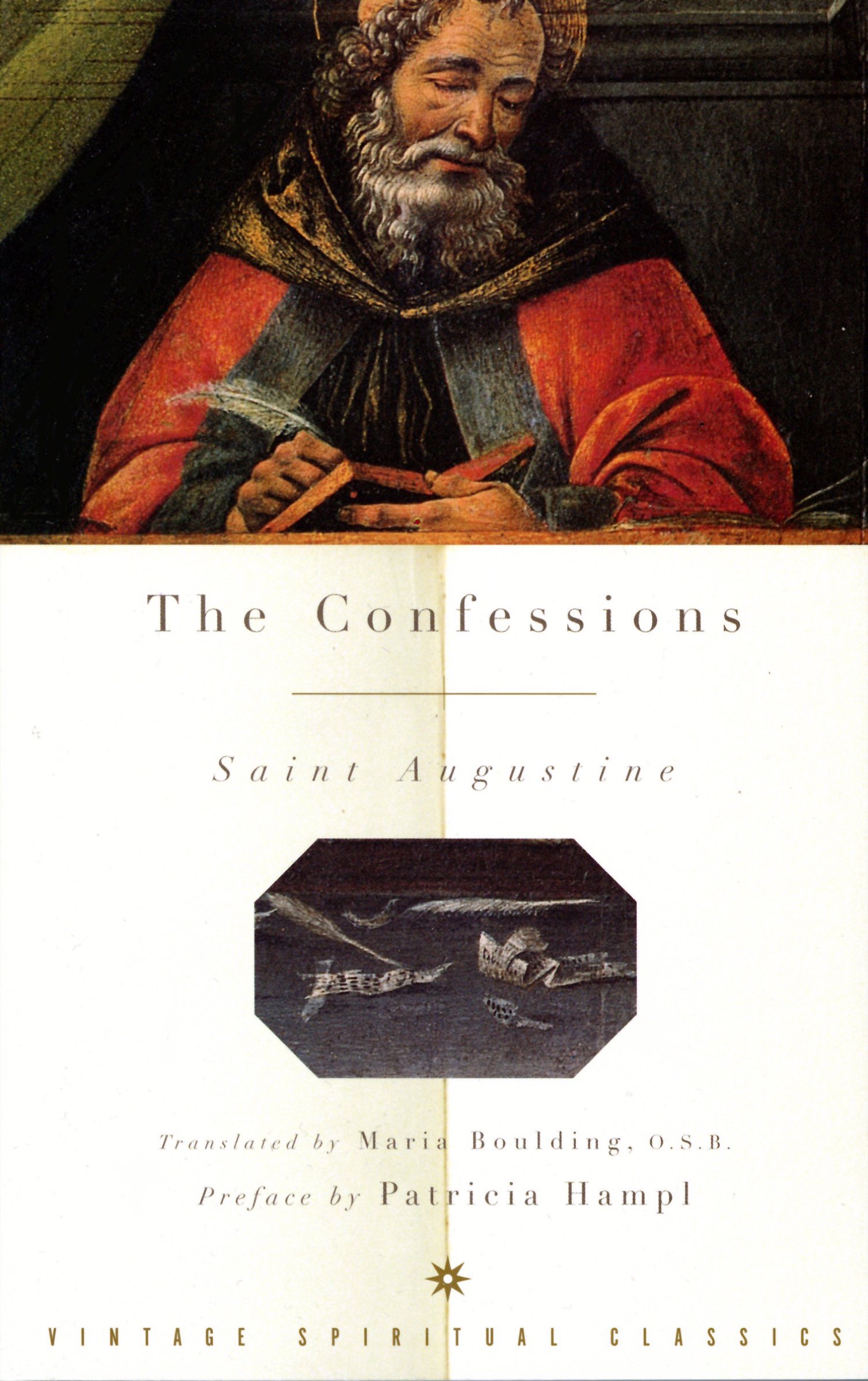
According to the back cover of my Maria Boulding translation, Confessions is “the first true autobiography in Western literature and among the most sophisticated yet accessible theological arguments in the history of Christianity.” The book is essentially written as a letter to God, and while the language may feel a bit flowery and archaic, Augustine’s reflections on memory, desire, guilt, ambition, faith, and self-understanding could just as easily have been written today as they were more than 1,500 years ago. I have no idea how to put together a cohesive summary on such an expansive religious text, so I'll just share a few random thoughts I had.
First, that Catholic guilt is really something else. Augustine writes with genuine anguish about stealing pears with his friends as a boy, about not knowing how to avoid sinning in his dreams, and about the difficulty of moderating his enjoyment of music and food so that those pleasures of the flesh do not become more satisfying to him than his love of God. What a way to live. And yet, he seems far more tormented by these relatively small failures than by the episode where he lived with a woman, had a child with her, decided he needed to stop living in sin, and became engaged to a more socially acceptable girl instead, causing the mother of his child to leave heartbroken. But he still had to wait for his fiancé to come of marriageable age, so instead of waiting alone, he found another woman to hook up with in the meantime. I don’t know. I feel like that might be a bigger deal than eating an extra chicken leg or singing a psalm at too jaunty a tempo, but then again, I’m not the saint here.
One section I really appreciated is Augustine’s reflection on the irrationality of chasing praise and recognition from other people. At one point, he admits that he would seek approval even from people he did not personally respect, simply because they were respected by others, and comments on how absurd that is. Augustine is ultimately getting at the idea that he should only be seeking God’s approval, not approval from other people. But I think the logic still holds even if you’re not religious. It’s a good reminder of how easy it is to mistake external praise for actual fulfillment, and how much better it would be to seek real, internal satisfaction instead of constantly chasing recognition from other people.
Aesthetically, the most beautiful section to me was the second half of Book IX, where Augustine honors his mother, Monica, after her death. It is tender and poetic and full of so much love. But of course, being my cynical self, I couldn’t help feeling a little put off by the way even this beautiful tribute falls into one of the oldest patterns in the world. To this day, women are so often eulogized in terms of their patience, selflessness, endurance, and willingness to sacrifice themselves for others, as if it would somehow diminish their womanhood to have achieved something for their own sake. In Monica’s case, it feels especially egregious because so much of Augustine’s praise is tied to the way she endured what sounds like an abusive and unfaithful marriage. He praises how “she served [her husband] as her lord,” how “by her conduct you made her beautiful in her husband’s eyes,” how “gently did she put up with his marital infidelities,” and how, though he was hot-tempered, “she learned to offer him no resistance.” I mean, good for her, I guess. But what a shame that this was the role she was forced to play, and that her greatness had to be expressed through how quietly and gracefully she suffered.
I enjoyed Augustine’s masterful logical takedown of astrology in Book VII. Books X–XII, titled “Memory,” “Time and Eternity,” and “Heaven and Earth,” are basically Augustine talking himself through a series of wild philosophical logic loops that would not feel out of place in a stoner’s basement. I honestly didn’t follow all of it, but I was fascinated by the process of watching someone try to think through the mysteries of the universe while maintaining an absolutely unwavering faith in God. I got a kick out of him constantly tripping over himself as he tries to stay in God's good graces throughout his musings. He pushes his own reasoning as far as it can go, then catches himself and reminds God that, obviously, he would never presume to question God’s wisdom.
In conclusion, Confessions is worth a read.
 kelsi’s reading diary