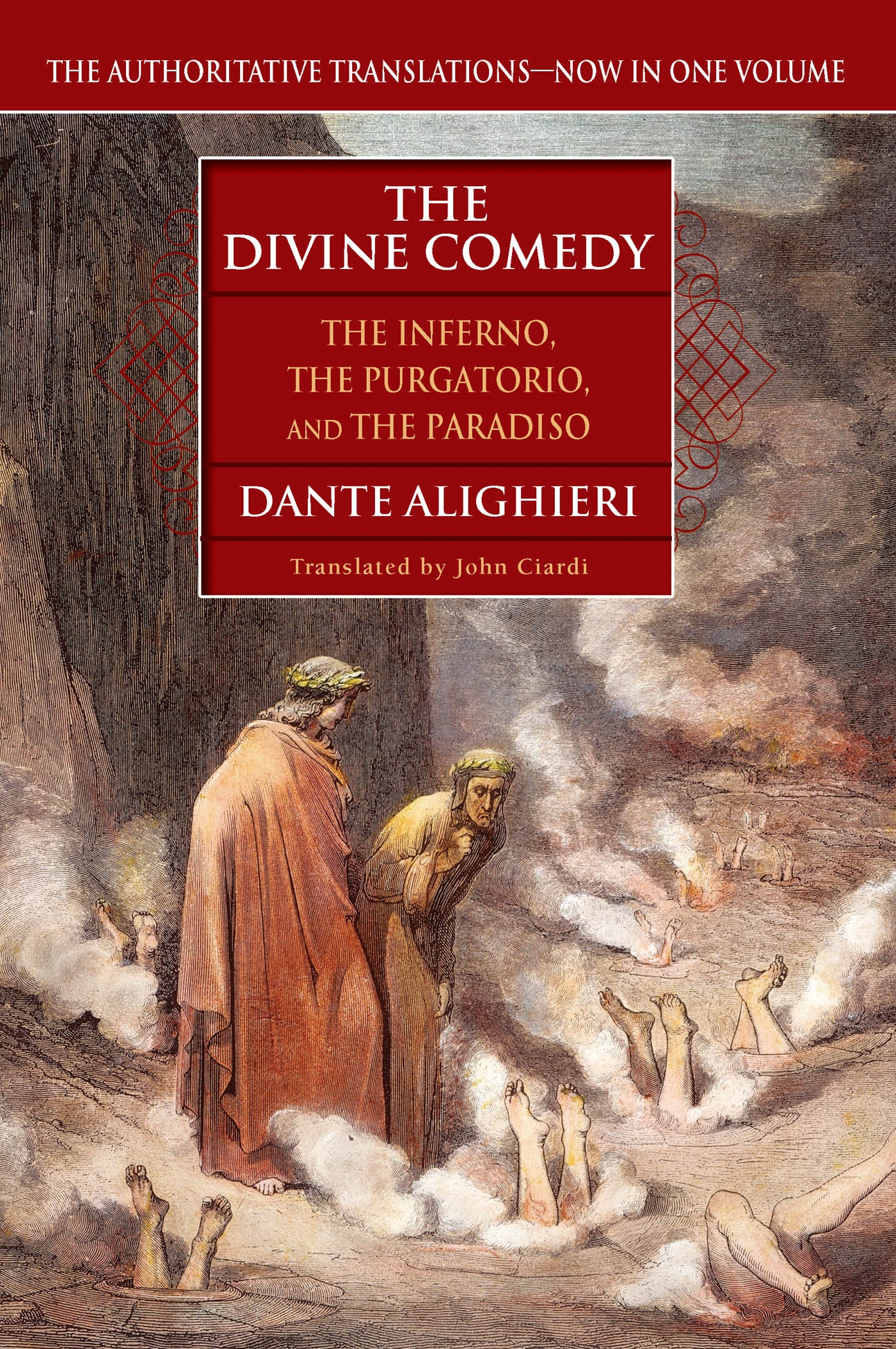
About the book
BOOK SUMMARY
Dante travels through Hell, Purgatory, and Heaven in this medieval Italian poem exploring the soul’s journey toward God and divine justice.
Published 1321
Epic Poem
928 pages
I must not be ready yet
August 23, 2026
My understanding of all-time literary greatness has long been that we have Shakespeare, and we have Dante, and then we have everyone else. In T.S. Eliot’s words, “Dante and Shakespeare divide the modern world between them; there is no third.” So I was eager to finally experience this greatness for myself.
Well, I worked my way through The Divine Comedy over the last few months, and I am embarrassed to say that I didn’t get it. I mean, I understood the general arc of the story. John Ciardi’s translation flows very well and is relatively easy to understand. But when it comes to understanding why this is considered one of the supreme achievements of world literature, I am clearly missing something.
Historically, I can appreciate what Dante accomplished by bringing together theology, philosophy, politics, history, and poetry on an unprecedented scale. Stylistically, I can appreciate the almost mathematical precision of its construction, although I’m sure a great deal of that is inevitably lost in translation.
But I never really cared about it. Very little stood out to me that left me pondering for long. The idea in Inferno that the punishments somehow reflect or embody the sins themselves was fascinating at first, and then after a while it just started to feel repetitive. I feel crazy for thinking that Dante’s frequent references to specific contemporary and historical Italians make the poem feel dated rather than universal.
The part that had me thinking the most was Dante’s hierarchy of sin. My first reaction was that it seemed completely backwards. How could falsifiers and fraudsters possibly belong below murderers? But the more I thought about it, the more I could see the logic that the worst sins are those that misuse our distinctly human capacity for reason. Not that I agree with it, but I respect the reasoning.
I’ll have to revisit this one someday. Maybe with more time spent on the historical context, and more willingness to slow down and dig into individual passages instead of pushing through the whole thing. Or maybe this is just one of those things I aren’t smart enough for.
 kelsi’s reading diary