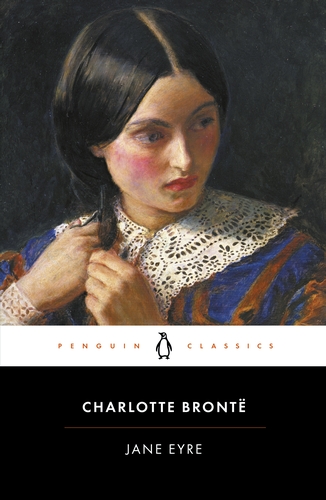
About the book
BOOK SUMMARY
After a difficult childhood, Jane Eyre becomes a governess at Thornfield Hall, where she falls in love with the guarded Mr. Rochester. As the house’s secrets emerge, she must decide what love can ask of her without sacrificing her independence or self-respect.
Published 1847
Gothic Fiction
624 pages
This might be my favorite book
September 6, 2026
I can’t believe this was the first time I’ve read Jane Eyre. It’s not unheard of for me to shed a few tears while reading a book, but this one had me sobbing to an unusual degree on multiple occasions. At the same time, I found it incredibly empowering and inspiring.
First of all, the interiority of the narration feels like a remarkable leap in the progression of literature. Jane Eyre was not the first novel to use first-person narration, but there is something special here about how we really get to feel deep emotions along with Jane. Her voice remains strong and recognizable from the very beginning, even as we watch her grow into a different person.
The structure of the story was excellent. The novel divides naturally into the distinct phases of Jane’s life: as a girl living with her aunt at Gateshead, as a student at Lowood, as a governess at Thornfield, during her time at Moor House, and finally in the life she chooses for herself. Each phase was well fleshed out so it was easy to feel like I was on the journey right alongside her.
But what really makes the book so great is Jane herself. She is undeniably admirable. She goes through all sorts of hell, and she doesn’t glide through it with perfect composure. She shows anger and suffering and desperation. At times she is openly defeated. But every time another hardship comes, she eventually picks herself up again. She becomes stronger without becoming bitter, and she continues developing a sense of who she is even when her circumstances constantly emphasize her insignificance. More importantly, once she has established that sense of self, she holds firmly to it. She does not allow poverty, religion, social expectations, or someone else’s wishes to determine the terms of her life.
Her journey is not linear, and even the ending isn’t a picture-perfect happily-ever-after. She has some big wins, but it’s clear that the life awaiting her is still going to have its fair share of difficulty. And yet, you come away feeling completely hopeful for her. Because by this point, Jane knows who she is and has built a life that doesn’t require her to compromise her identity. Whatever comes next, you trust that she’ll be able to handle it, and that she’ll find happiness even when things aren’t easy.
In addition to Jane, there is a lot to say about the wonderful cast of supporting characters as well. Helen Burns is probably the first and most important. She is present for only a short portion of the novel, fairly early on, and yet she may have the greatest influence on Jane of anyone in the entire story. Jane begins the book ready to fight every injustice inflicted upon her. And then Helen comes along and shows her an alternative path of patience, forgiveness, faith, and the ability to maintain an inner peace that other people cannot take away from you.
I absolutely adored Helen. She might be one of the most beautiful characters I’ve ever read. A cynical part of me could argue that she is too good to be believable, and yet I completely believed in her. Her final scene was perfectly heartbreaking. I don’t believe I could ever be a Helen, but she’s an inspiration nonetheless.
St. John is kind of an interesting contrast to Helen later in the novel. He is also deeply religious, but where Helen’s faith seems to enlarge her humanity, St. John’s begins to consume him a bit, I think. He maintains a sense of duty that is so absolute that he seems to lose sight of the real meaning behind it. I like how Jane is able to hold affection for St. John and learn from him while also recognizing his weaknesses.
Then we have Mr. Rochester, who is an effective counterpart to Jane exactly because he is not an obvious romantic ideal. He has a questionable history with women. We are told repeatedly that he is not handsome, even at his best. He is awkward and off-putting. And yet, if I trust anyone to see a person’s true character and know when they are worthy of forgiveness, it’s Jane. And I love that Jane never settles, and she does not allow herself to get stuck in a powerless relationship. It’s a romance that doesn’t represent the ultimate measure of Jane’s happiness.
The most uncomfortable part of the book is Bertha, Rochester’s first wife. Through a modern lens, it’s difficult not to feel sympathy for how dehumanized she is. We only really know her through Rochester’s account and through a few mysterious glimpses of her. It is one of the few parts of the novel where I felt a little conflicted, because I was obviously rooting for Jane, but didn’t love how Bertha was treated.
But in summary, I loved this. Incredible characters, beautiful story, and a powerful message about staying strong and finding happiness no matter where you are in life. And also, just packed with quotable lines. I’ll add a few here:
Book Quotes
“Even for me life had its gleams of sunshine.”
— Chapter 4
“It is far better to endure patiently a smart which nobody feels but yourself, than to commit a hasty action whose evil consequences will extend to all connected with you.”
— Chapter 6
“Yet it would be your duty to bear it, if you could not avoid it: it is weak and silly to say you cannot bear what it is your fate to be required to bear.”
— Chapter 6
“If all the world hated you, and believed you wicked, while your own conscience approved you, and absolved you from guilt, you would not be without friends.”
— Chapter 8
“Women are supposed to be very calm generally: but women feel just as men feel; they need exercise for their faculties, and a field for their efforts, as much as their brothers do; they suffer from too rigid a restraint, too absolute a stagnation, precisely as men would suffer; and it is narrow-minded in their more privileged fellow-creatures to say that they ought to confine themselves to making puddings and knitting stockings, to playing on the piano and embroidering bags. It is thoughtless to condemn them, or laugh at them, if they seek to do more or learn more than custom has pronounced necessary for their sex.”
— Chapter 12
“I can live alone, if self-respect, and circumstances require me so to do. I need not sell my soul to buy bliss. I have an inward treasure born with me, which can keep me alive if all extraneous delights should be withheld, or offered only at a price I cannot afford to give.”
— Chapter 19
“Do you think, because I am poor, obscure, plain, and little, I am soulless and heartless? You think wrong!—I have as much soul as you,—and full as much heart!”
— Chapter 23
“I am no bird; and no net ensnares me; I am a free human being with an independent will, which I now exert to leave you.”
— Chapter 23
“I am not an angel,” I asserted; “and I will not be one till I die: I will be myself.”
— Chapter 24
“Prejudices, it is well known, are most difficult to eradicate from the heart whose soil has never been loosened or fertilised by education: they grow there, firm as weeds among stones.”
— Chapter 29
 kelsi’s reading diary