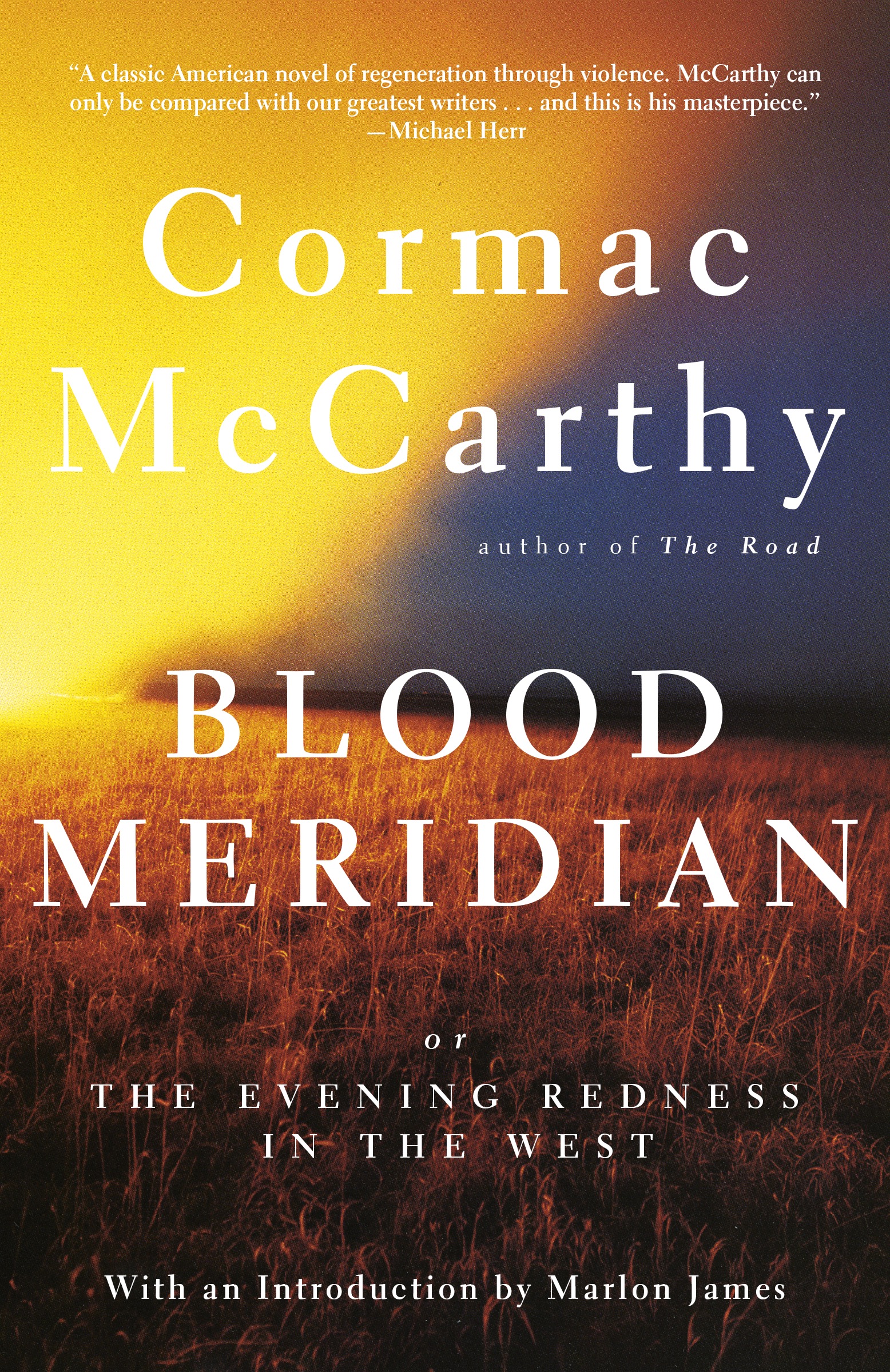
About the book
BOOK SUMMARY
A fourteen-year-old Tennessean faces the violent Glanton gang and Judge Holden during their Indian-scalping mission in the 1850s American West.
Published 1985
Historical Fiction
368 pages
The prose is absolutely bananas
April 19, 2026
This might be the first time I withhold a five-star rating, not because the book doesn’t deserve it, but because I’m not sure I’ve earned the right to give it one. There is so much depth to this book that I am able to sense but not totally comprehend. I need to come back and re-read after I've had some exposure to Milton and Melville and Faulkner. I'm clearly meant to have some grander literary awakening here that I'm not prepared for.
What I can say is this: the prose is absolutely bananas. It's gorgeous and vicious and jammed-packed with words I didn't know existed. The only thing I know to compare the style to is the bible. I'd find myself in the middle of a paragraph, realizing I wasn't quite sure what was going on other than the language was incredible. We get the most complicated, elegant description of some ultra-bleak landscape or brutally violent scene, followed up by a nonchalant "They rode on." Like nothing happened. The most inconsequential details will be described in intense detail, but then we'll fast-forward through major events, and it's a real trip.
The judge is a captivating and horrible character. I'm not sure what to think of the kid. Most of the other characters are fairly interchangeable as far as I'm concerned, just as other natural entities like rocks or birds or trees are fairly interchangeable, because they all just represent agents of violence.
A major message of Blood Meridian seems to be that humanity’s natural state is violence, at least according to the judge. But women are almost entirely absent from the narrative, and when they do appear, they are usually nameless prostitutes or villagers. So is the novel really making a claim about human nature, or is it making a claim about men? And how much thought did McCarthy give to women’s perspectives as he developed the novel’s themes? I’m not saying he needed to center women if his subject was specifically male violence, but it would hardly be unusual for a writer to treat men’s experiences as universal and apply them to humanity as a whole.
 kelsi’s reading diary