About the book
BOOK SUMMARY
An ancient Indian epic following Prince Rama, an incarnation of Lord Visnu, who must defeat the demon Ravana while navigating family relationships, love, duty, and palace intrigue.
Published 500 BCE
Epic Poem
571 pages
Hilariously extreme exaggerations
May 15, 2026
“Diwali is a celebration of the coronation of the god king Rama after his epic battle with Ravena, the demon king of Lanka. It symbolizes the battle between good and evil.”
— Dwight Schrute
I had some idea that The Ramayana is a major work in ancient Indian literature, and in my mind I related it to something like The Iliad or The Odyssey or The Aeneid. Or maybe even the Bible. But somehow it wasn’t until I was almost halfway through that I realized that it’s also the origin story of Diwali, and that Dwight captured it pretty perfectly in the quote above.
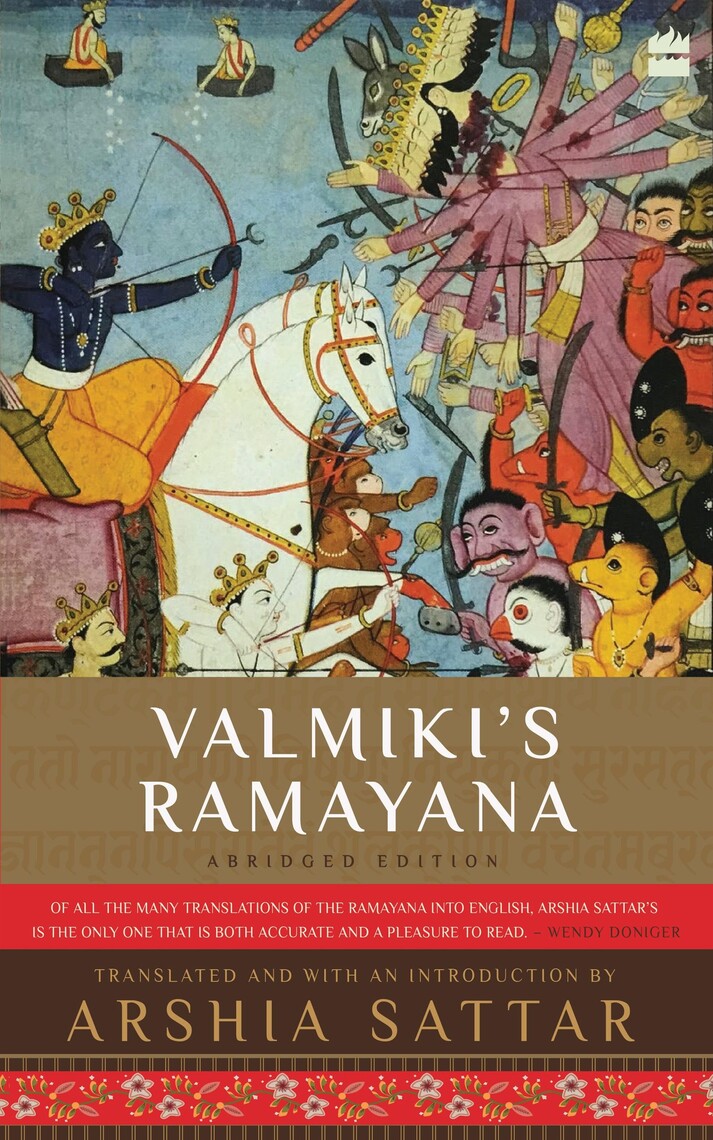
I read the abridged (still almost 600 pages) prose translation from Arshia Sattar, and it was pretty darn entertaining. I don’t actually have any basis for comparison for how good this particular translation is, but some woman named Wendy Doniger is quoted on the cover as saying, “Of all the many translations of The Ramayana into English, this is the only one that is both accurate and a pleasure to read,” and I’m inclined to believe her.
The story is one big adventure quest that is actually pretty engaging. The Ramayana takes the hilariously extreme exaggerations ancient texts tend to use to a whole new level. Monkeys grow to the size of mountains and leap across oceans. Thousands of millions of warriors team up to fight. Everybody lives for a thousand years and has a thousand sons. Warriors are pierced by one hundred arrows and then get up to keep fighting.
A lot of the descriptions and analogies throughout the book are (sometimes intentionally, sometimes unintentionally) funny, especially when it comes to describing women’s bodies. There are great lines such as, “Your breasts rise up to your shoulders as if to rival them.” And, “Your hips are wide and your thighs are as strong as an elephant trunk.”
It’s really interesting to compare how Rama is depicted in The Ramayana with how figures like Menelaus, Odysseus, or Aeneas are depicted in Greek and Roman literature. I think those differences reveal a lot about what each culture most wanted to idealize in a hero, though obviously I’m working from a small sample of texts with very different aims and contexts.
Aside from being perfect in every way, the Ramayana specifically emphasizes Rama’s righteousness, including his commitment to dharma, his restraint, his compassion, his willingness to protect innocent beings, and his responsibility to his people. He is handsome, strong, and a great warrior, of course, but he is also humble, forgiving, and even kind. Meanwhile, Greek and Roman heroics seem to focus more exclusively on glory, honor, status, battlefield excellence, and building a public reputation.
It was also tempting to compare Rama with Menelaus, since both men have their wives taken from them. (Although Sita is much more similar to Penelope than Helen in terms of perceived loyalty.) When Sita is abducted, Rama seems devastated not just because his wife has been taken, but because he loves her, wants to be with her, and feels that he has failed to protect her. Menelaus, on the other hand, does seem wounded by Helen’s loss, but he mostly seems worried about the public humiliation it caused him and the need to restore his pride and authority.
So Rama seemed like the better guy, until the very end when he completely ruined my perception of him by giving a speech about how he rescued Sita only to restore his own honor and suggesting he would accept her burning herself alive to prove her purity. Ugh. Come on, Rama.
The Ramayana seems to give women a more central role in the story compared to women in Greek and Roman epics. Sita is given somewhat of her own personality and is often praised in her own right, albeit for a limited set of acceptable feminine characteristics, such as beauty, loyalty, patience, and purity. This compares to women like Helen, who is treated less as a fully developed person and more like a beautiful object around whom male desire, honor, and conflict revolve.
Even The Ramayana’s primary villain, Ravana, shows some level of decency towards women, when, after he kidnaps Sita, he says, “A woman cannot act against the wishes of the woman that he desires” and doesn’t lay with her while he doesn’t have her consent.
Still, that is not to say The Ramayana reflects a view of women that would feel acceptable by modern Western standards, or that Greek and Roman literature does either. In each case, women are often constrained to very specific roles, and their value is frequently tied to sexual purity, obedience, beauty, motherhood, or their relationship to men. On multiple occasions in The Ramaya, women are generalized in openly negative ways, as if fickleness, emotional instability, or mischief are simply part of female nature. For example, at one point, Lakshmana tells Sita, “Women are like this everywhere in the world. They are unrighteous and fickle and they breed mischief.”
As a side note, I really had to expand my vocabulary reading this. You will very quickly become familiar with a handful of words that seem to appear on just about every page, such as rashaka, dharma, boon, ascetic, auspicious, and austerities.
Also, I almost wish I had skipped the first kanda, or left it for later, because the main story doesn’t really start until the second kanda. The first part almost scared me away by introducing like a dozen new complex Indian names per page, but the plot started to flow a lot smoother after that.
 kelsi’s reading diary